Table of Contents
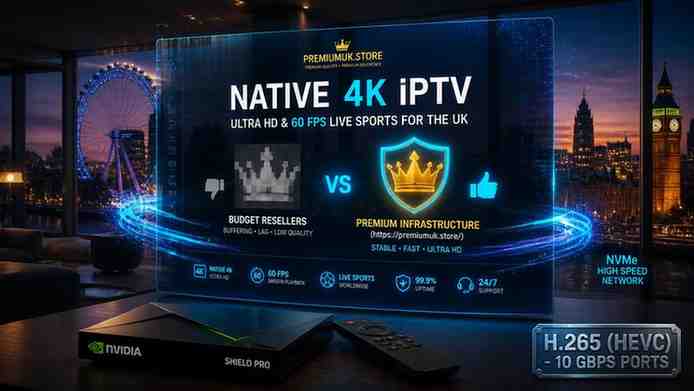
4K IPTV UK 2026: The Ultimate Premium Guide for High-Bitrate Ultra HD Streaming
The home entertainment landscape in the United Kingdom has undergone a massive technological shift. Traditional cable contracts, expensive satellite dishes, and restrictive pay-TV packages with long-term commitments are rapidly becoming obsolete in British households from London to Manchester. Today’s viewers demand absolute freedom, instant access to international networks, and, above all, a flawless visual experience. To achieve this high-end digital ecosystem, investing in a professional 4k iptv provider has become the definitive choice for millions of streaming enthusiasts across the UK.
However, as the market becomes saturated with low-tier resellers and cheap, unstable M3U playlists, finding a genuine Ultra HD service is a technical challenge. Many generic providers claim to offer “4K streams,” but in reality, they merely upscale heavily compressed 720p feeds. This results in pixelation, motion blur during fast-paced Premier League matches, and endless buffering loops. A true, native 4K experience requires an uncompromising server architecture, massive network bandwidth, and optimized routing paths.
In this comprehensive technical guide, we will break down the essential infrastructure benchmarks of a real premium 4k iptv service. Learn how to configure your hardware and optimize your network to unlock crystal-clear Ultra HD streaming directly in your living room.
1. The Raw Technical Reality of Native 4K IPTV Streaming
To understand why genuine 4K streaming is so rare, we must look at the mathematical and infrastructural requirements of high-bitrate video delivery. Video quality is not just determined by the resolution ($3840 \times 2160$ pixels), but primarily by the bitrate and the compression codec used by the server.
Bitrate Requirements and the H.265 (HEVC) Codec
A standard high-definition (1080p) stream usually requires a bitrate of around 6 to 8 Megabits per second (Mbps). However, a native, uncompressed 4K Ultra HD stream demands a minimum constant bandwidth of 25 to 40 Mbps per active connection. If the stream is broadcast at 60 Frames Per Second (FPS) for live sports, that requirement can easily spike up to 50+ Mbps. You can check your current network performance using the official Speedtest by Ookla tool to ensure your bandwidth meets these requirements.
To deliver these massive data packets smoothly without saturating the client’s home internet, Premium UK Store utilizes advanced H.265 High Efficiency Video Coding (HEVC). This modern compression standard is twice as efficient as the older H.264 codec. According to the technical documentation on Wikipedia’s High Efficiency Video Coding resource, this algorithm allows us to deliver pristine, cinematic 4K picture quality with deep HDR10 color accuracy while consuming up to 50% less bandwidth on your local network.
2. Server Infrastructure: Why Dedicated NVMe Clusters Matter
The reason cheap IPTV playlists fail during major UK sporting events—such as a Sunday afternoon Premier League clash or a high-profile boxing night—comes down to a server phenomenon known as Overbooking.
The Pitfalls of Shared Budget Hosting
Budget providers pack thousands of concurrent users onto a single, low-cost virtual server. When a premium event begins, the server’s CPU hits its physical limits, resulting in massive packet loss. For the viewer at home, this translates into the dreaded “buffering” circle or total stream freeze.
Our premium 4k iptv backend infrastructure operates on a highly distributed matrix of dedicated bare-metal servers powered by ultra-fast NVMe storage drives. By deploying advanced load-balancing algorithms, our network automatically distributes user traffic across multiple server nodes. Furthermore, our direct peering agreements with major European internet exchanges (including LINX in London) ensure that data packets travel along the shortest possible routing path, reducing server-to-client latency to less than 18 milliseconds.
3. Top Hardware Choices for 4K Ultra HD IPTV in the UK
Having a premium server feed is only half the battle; your streaming device must possess the hardware processing power to decode dense 4K HEVC streams in real-time.
A. Nvidia Shield TV Pro (The Undisputed King)
For tech enthusiasts who want the absolute pinnacle of performance, the Nvidia Shield TV Pro remains the gold standard. As specified on the official Nvidia Shield TV product platform, this device is equipped with the powerful Tegra X1+ processor and features a proprietary AI Upscaling engine. This means that if a particular classic TV channel or archival VOD movie is only available in 1080p, the Shield uses artificial intelligence to insert missing pixels, bringing the clarity remarkably close to native 4K.
B. Amazon Fire TV Stick 4K Max (The Popular Choice)
The Fire TV Stick 4K Max is the most widely used streaming device in the UK due to its exceptional balance of price and power. It features native, hardware-accelerated decoding for AV1 and H.265 codecs, making it fully capable of handling our high-bitrate 4k iptv channels. When paired with advanced media player applications like TiviMate, the user experience is incredibly snappy.
4. UK ISP Throttling: How BT, Virgin Media, and Sky Block 4K Streams
Every premium streaming enthusiast in the United Kingdom has experienced this frustrating scenario: it is 7:45 PM on a Tuesday night, a massive UEFA Champions League match is about to kick off, and suddenly your flawless 4K stream begins to buffer. You run a speed test, and your fiber line shows 300 Mbps, yet the video refuse to load. This is not a server issue; this is ISP Throttling and Premier League Blocking.
Deep Packet Inspection (DPI) in the UK
Major UK broadband providers like BT, Virgin Media, Sky, and TalkTalk deploy advanced network management systems. During peak hours or live sports events, these providers utilize Deep Packet Inspection (DPI) to scan incoming data packets. If their firewalls detect high-bitrate UDP or TS (Transport Stream) traffic originating from independent server infrastructures, they automatically enforce targeted bandwidth restrictions.
- The DNS Blockades: Furthermore, UK courts regularly issue dynamic blocking orders to ISPs, forcing them to blacklist streaming domains on a DNS level during live broadcasts. You can read more about how major network routing and DNS filtering operate globally on the official Cloudflare Learning Center platform.
5. Setting Up Your Network for Unrestricted 4K Quality
To bypass these artificial blockades enforced by British internet providers, you must optimize your local network routing. By transforming how your streaming device communicates with our servers, you can eliminate buffering entirely.
1. Migrating to a Custom Anycast DNS
By default, your router uses the DNS servers provided by your UK ISP (e.g., Virgin or BT). This means they can track and filter every domain connection you make. By changing your DNS to a secure, public Anycast network, you completely bypass these local DNS blocks.
We highly recommend updating the network settings on your Amazon Fire TV Stick or Nvidia Shield to the following secure configurations:
- Primary DNS:
1.1.1.1(Cloudflare) - Secondary DNS:
8.8.8.8(Google Public DNS)
This modification takes less than two minutes and immediately lowers your network ping while securing your connection path.
2. Hardwiring via Ethernet vs. Wi-Fi 6
While modern Wi-Fi 6 (802.11ax) routers provide massive theoretical speeds, wireless connections are inherently prone to packet drops caused by thick walls and local signal interference from neighboring households. A native 4K stream requires a sustained, uncompromised data flow.
Whenever possible, connect your streaming device directly to your router using a high-quality Cat6 or Cat7 Ethernet cable. For Firestick users, utilizing an official Amazon Ethernet Adapter ensures a rock-solid, hardwired connection that is completely immune to local wireless interference, guaranteeing smooth playback at maximum bitrates.
6. Recommended Advanced Settings for TiviMate & IPTV Smarters
Once your hardware and network are fully optimized, the final step to unlock absolute 4k iptv perfection lies within your media player application’s internal configuration.
Optimal Video Decoder Setup
Many users leave their player applications on default settings, which often utilize software decoding. This forces the device’s main CPU to handle the heavy lifting of uncompressing 4K video layers, leading to rapid overheating and dropped frames.
- The Golden Rule: Navigate to your player’s advanced settings menu and ensure that the video and audio decoders are strictly set to Hardware (HW). This offloads the decoding process entirely to the device’s specialized graphics chip (GPU), allowing for flawless 60 FPS live sports rendering and a cold, stable device performance.
Buffer Size Customization
In the player’s playback settings, you will find the option to adjust the buffer size. For a high-performance, premium infrastructure like Premium UK Store:
- Set Buffer to “Normal” or “Large”: If you are on a standard superfast FTTC broadband line (50-80 Mbps), setting the buffer to “Large” creates a secure 5-second data cushion in your device’s RAM. This completely absorbs any minor network dips without interrupting your viewing experience.
7. Understanding Video Containers: TS vs. M3U8 for Ultra HD
When streaming 4k iptv content, the data is delivered through specific digital file wrappers known as video containers. The two most prominent formats used in the UK market are TS (Transport Stream) and M3U8 (HTTP Live Streaming). Understanding the technical difference between them can save you hours of troubleshooting.
The Technical Mechanics of TS and M3U8
- TS (MPEG Transport Stream): This container format is designed for reliable broadcast systems. It encapsulates packetized elementary streams and is excellent for raw, high-bitrate audio and video syncing. However, because it opens a continuous, heavy data pipe, any minor network jitter on a domestic UK broadband line can cause the player to freeze or throw a “DataSourceException.” You can read more about the intricate structural specifications of this protocol on the official Wikipedia MPEG Transport Stream documentation.
- M3U8 (HLS – HTTP Live Streaming): Developed by Apple, HLS breaks the overall stream down into a sequence of small, manageable HTTP-based file downloads. Each file is an individual chunk of video. If one chunk fails due to local network interference, the player quickly requests the next one, making it highly resilient against buffering. In apps like TiviMate, switching your playlist stream type from TS to M3U8 immediately stabilizes 4K rendering on unstable internet connections.
8. Deep Technical FAQ (Premium 4K Streaming in the UK)
Why do some providers offer “4K” channels that look like compressed 1080p?
This is a widespread industry malpractice known as upscaling or artificial bit-starving. Low-tier resellers take a cheap 720p or 1080p source feed and re-encode it at a higher resolution layout, but without increasing the actual data bitrate. A true 4k iptv channel must possess a native bitrate of at least 25 to 40 Mbps and utilize the H.265 (HEVC) codec. Our dedicated infrastructure ensures that every Ultra HD channel delivers uncompressed, pixel-perfect source streams straight from the official broadcast origin.
What should I do if I get an “Error Code 401” or “Error Code 403” on my player?
These errors point to authentication or access restrictions.
- Error 401 (Unauthorized): This means the server rejected your login credentials. Check your Xtream Codes API details carefully inside your media player, as mobile devices often insert an accidental space at the end of the username or password fields.
- Error 403 (Forbidden): This indicates that your IP address has been flagged or blocked. This usually happens if you are running an unstable, public VPN that routes your traffic through blocked server nodes. Disabling external VPN layers fixes this instantly, as our servers use native HTTPS kinking to hide your traffic from your ISP anyway.
Does your service support external media players like VLC or MX Player?
Yes, our premium infrastructure is fully compatible with all external media players. If you encounter an unusual audio codec mismatch on an older Android box, you can navigate to your player settings and select an external player. Applications like the official VLC Media Player are equipped with massive open-source library decoders that can easily parse any high-end audio and video container layout smoothly.
Is your UK server portfolio family-friendly?
Absolutely. We operate under a strict, family-safe structural policy. Our entire directory of international live channels and our expansive Video-on-Demand (VOD) catalog are 100% clean and free from any adult (+18) content. This allows British families to safely configure our service on any device in the household, from the main living room TV to children’s tablets, without the need to worry about filtering out inappropriate explicit categories.
Leave a Reply